13-10-2026
Interlocking Bricks vs Mud Bricks, Red Bricks and Hollow Blocks: Which Is Best for Low-Cost House Construction?
By Kanagu Builders Team
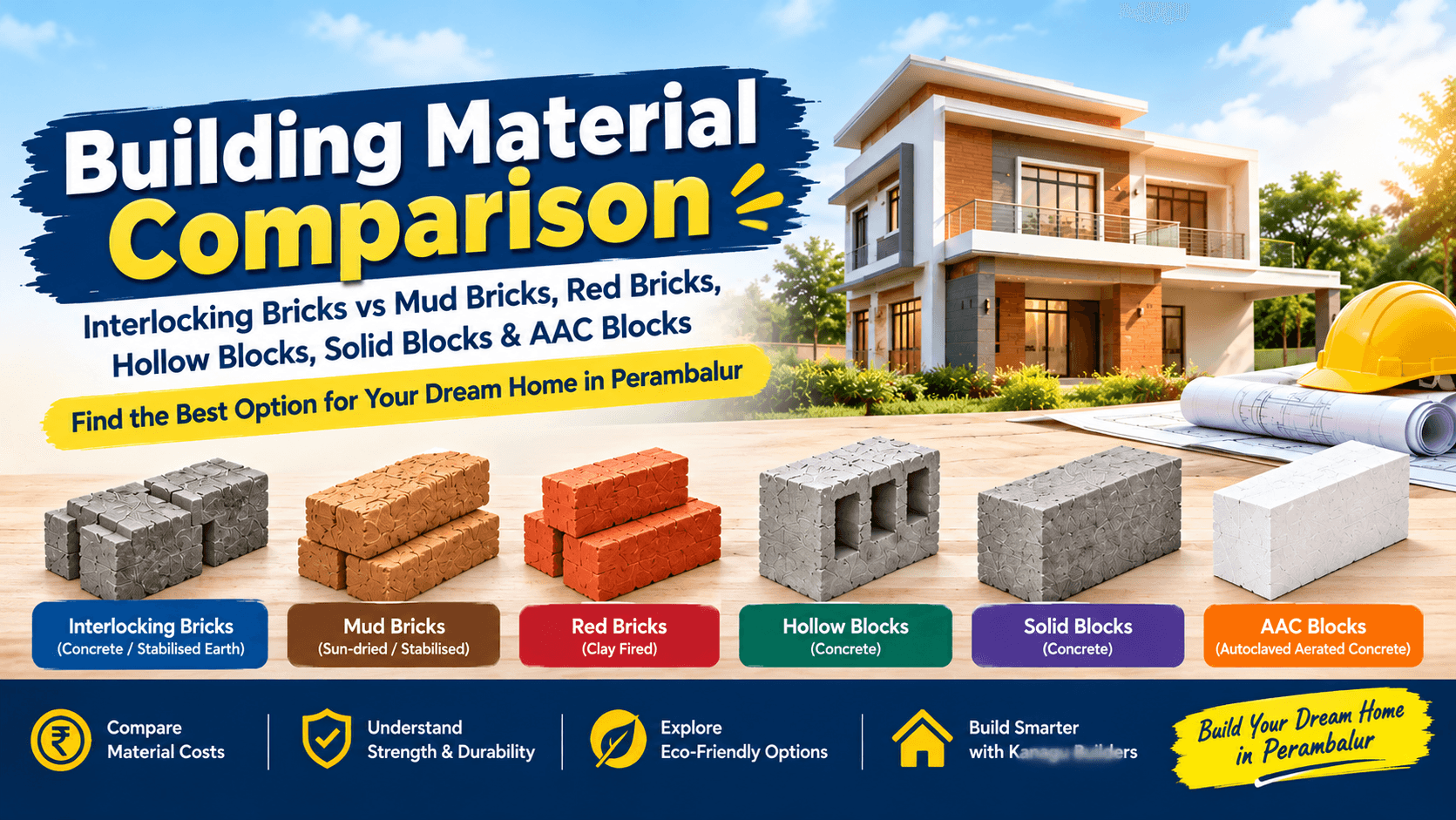
Building your own home is a dream for many families. But with the rising cost of construction materials, cement, sand and labour, one question matters more than ever: How can you build a strong, comfortable home without spending more than necessary?
One way to explore construction savings is to choose the right wall-building material.
Traditional red bricks remain popular, while mud bricks, hollow concrete blocks, solid concrete blocks, AAC blocks and interlocking bricks offer different advantages. Among these options, interlocking bricks can be particularly interesting because certain systems reduce mortar consumption and simplify wall construction.
If you are planning to build a house in Perambalur, Tamil Nadu, this guide will help you compare these materials, understand their cost implications and decide which option deserves consideration for your project.
Kanagu Builders helps homeowners explore interlocking brick construction and other construction options to plan buildings according to their requirements.
What Are Interlocking Bricks?
Interlocking bricks are specially shaped blocks designed to fit together through matching grooves, projections or profiles.
Depending on the product, they may be manufactured using stabilised soil, compressed earth or concrete. Some systems require little mortar between blocks, while others use mortar, grout or reinforcement as specified by the manufacturer.
Their main attraction is construction efficiency. By reducing certain masonry operations, a suitable interlocking system may help save time, labour and some finishing costs.
However, not all interlocking bricks are identical. The material, block dimensions, strength, manufacturing quality and installation method determine their performance and final cost.
Comparing 6 Building Materials for Cost-Effective Construction
Before choosing interlocking bricks, let's compare them with other commonly used masonry materials.
1. Traditional mud bricks
Traditional mud bricks are made from soil and dried, usually without kiln firing. They can be economical where suitable soil and local manufacturing facilities are available.
Advantages
- Potentially low material and manufacturing costs.
- Lower manufacturing energy requirements than fired clay bricks.
- Useful for appropriate traditional or natural building designs.
Limitations
- Ordinary sun-dried mud bricks can be vulnerable to moisture and erosion.
- They may require protective finishes and careful detailing.
- Their strength and consistency depend heavily on soil quality and manufacturing.
Cost perspective: Low material cost does not automatically mean low total construction cost. Additional protection, finishing and maintenance must be included.
2. Traditional red clay bricks
Red bricks are made from clay and fired in kilns. They remain widely used because many builders and masons are familiar with conventional brick masonry.
Advantages
- Widely available in many locations.
- Familiar construction techniques and established detailing practices.
- Suitable grades are available for different masonry applications.
Limitations
- Numerous small units require many mortar joints.
- Masonry may take longer than construction with larger blocks.
- Plastering and other finishes can add to the overall expense.
Cost perspective: Red bricks can be practical when local supply, labour availability and established construction methods make them competitive.
3. Stabilised mud interlocking bricks
These blocks are made by compressing a suitable soil mixture, sometimes with cement or lime as a stabiliser. Their interlocking profiles help align the blocks during construction.
Advantages
- May reduce mortar consumption.
- Can offer an attractive exposed-earth finish.
- Avoiding kiln firing may reduce manufacturing energy requirements.
- May improve construction efficiency with trained workers.
Limitations
- Requires appropriate soil selection, manufacturing quality and curing.
- Needs suitable moisture protection and weather detailing.
- Structural suitability must be confirmed for the intended building.
Cost perspective: This option can be worth evaluating when reduced mortar and finishing requirements offset the block price and any additional installation requirements.
4. Hollow concrete blocks
Hollow concrete blocks contain cavities that reduce material use compared with equivalent solid concrete units. Their larger size can speed up wall construction.
Advantages
- Fewer units are needed than with small conventional bricks.
- Potentially faster wall laying.
- Can be economical for suitable partition and infill walls.
Limitations
- Strength and suitability vary by block grade and design.
- Some applications need reinforcement, special detailing or surface finishing.
- Chasing services and fixing heavy objects require appropriate planning.
Cost perspective: Hollow blocks can be a strong contender for economical construction. Compare their complete installed-wall cost against the interlocking system rather than assuming one is cheaper.
5. Solid concrete blocks
Solid concrete blocks are dense, cement-based masonry units that can be used in applications suited to their specified strength.
Advantages
- Larger dimensions can reduce the number of masonry joints.
- Suitable grades offer useful compressive strength.
- Familiar option for many concrete-block construction projects.
Limitations
- They can be heavier than some alternative blocks.
- Their density and thermal properties vary by product.
- Mortar, labour and finishing still contribute to total cost.
Cost perspective: They may be competitive where block availability and labour rates are favourable, but their weight and design requirements should also be considered.
6. AAC blocks
Autoclaved aerated concrete (AAC) blocks are lightweight, factory-manufactured masonry units with a cellular structure.
Advantages
- Lower weight than conventional solid masonry units.
- Good thermal insulation compared with many denser masonry materials.
- Large block dimensions can accelerate construction.
- Usually laid using a specified thin-bed adhesive.
Limitations
- Material prices and transport costs vary.
- Specialised adhesive and suitable finishing methods are important.
- Appropriate fixings and construction detailing are needed.
Cost perspective: AAC blocks may reduce certain labour and finishing expenses, but the final result depends on the complete wall system and local pricing.
Interlocking Bricks vs Other Bricks: Comparison
The most useful comparison is not simply the price of one brick or block. It is the comparison of one square foot of finished wall.
Potential savings where installation and finishing efficiencies are realised
Traditional mud bricks and stabilised mud interlocking blocks are different products, and their costs should not be treated as interchangeable.
Which option can reduce your construction cost the most?
There is no universal winner.
Hollow concrete blocks may be economical for certain walls. AAC blocks may offer savings through lower weight and faster installation. Stabilised mud interlocking bricks may offer advantages through reduced mortar and suitable exposed finishes. Red bricks can remain competitive when local prices and labour are favourable.
The right choice depends on your building design, the wall's intended function, local material prices, transportation, labour, structural requirements and finish.
How Interlocking Bricks Can Help Reduce Construction Costs
If you are comparing materials for a new house, these are the potential cost-saving opportunities worth investigating.
1. Reduced mortar consumption
Certain interlocking systems fit together with less mortar between blocks than conventional masonry.
Depending on the design, this can reduce some cement, sand and mixing labour. The actual saving depends on the block system and whether mortar is still required for joints, grouting or structural detailing.
2. Potentially lower masonry labour costs
Interlocking profiles can help with alignment, and some systems are quicker to lay once workers are familiar with them.
A shorter masonry schedule may reduce labour expenses, but this depends on block handling, worker experience and site conditions.
3. Possible savings on plastering
Some interlocking blocks are designed for exposed masonry finishes. If the manufacturer and project specifications permit this finish, selected plastering work may be avoided.
This can be a significant cost consideration, but exposed walls need appropriate protection, especially where moisture, rain or surface durability are concerns.
4. Faster progress on suitable projects
A more efficient wall-building method may help the project move forward sooner. Depending on the schedule, this can reduce certain site-related expenses.
However, faster wall construction does not automatically shorten every stage of the house-building process.
5. Potential long-term benefits
The right wall system can contribute to durability, thermal comfort and manageable maintenance when designed and built properly.
For earth-based interlocking blocks, quality control and moisture protection are particularly important. For all systems, suitable construction detailing helps avoid costly repairs.
A Simple Way to Calculate the Real Savings
Before selecting a wall material, ask your contractor to prepare an itemised comparison for the same wall area and specification.
Include:
- Cost of blocks or bricks.
- Mortar, cement, sand or adhesive.
- Masonry labour.
- Plastering, putty and painting.
- Transport, loading and wastage.
- Waterproofing and other protective finishes.
- Any additional reinforcement or structural requirements.
For example, if an interlocking system has a higher purchase price but reduces mortar, labour and permitted finishing work, its total installed cost may still be competitive.
Conversely, a low-cost block may turn out more expensive once transport, plastering and other requirements are included.
The best way to reduce construction costs is to compare complete, itemised estimates—not just the price per brick.
Are Interlocking Bricks Suitable for House Construction in Perambalur?
Interlocking bricks can be considered for suitable residential and other construction projects in Perambalur, provided the selected system meets the project's structural and weather-protection requirements.
Before finalising your decision, check these five points:
- Block quality: Request relevant test results for strength and water absorption.
- Structural suitability: Have a qualified engineer approve the block system and wall design.
- Weather protection: Plan damp-proofing, drainage, plinth protection and appropriate wall finishes.
- Local cost: Compare delivered material prices, labour and finishing costs.
- Builder experience: Make sure the construction team understands the selected interlocking system and its installation requirements.
These checks help ensure that a cost-saving decision does not compromise the quality or safety of your home.
Build Smart with Kanagu Builders in Perambalur
Choosing a construction material is an important decision, but selecting the right construction partner matters just as much.
Kanagu Builders helps homeowners explore interlocking brick construction and plan suitable projects in Perambalur. Whether you are planning an independent house, a farmhouse, a commercial building or another construction project, discuss your budget, preferred materials and design requirements with the team.
Rather than choosing materials based only on their initial price, consider how each option affects the complete project cost.
Planning a low-cost house in Perambalur? Contact Kanagu Builders to discuss interlocking bricks, compare suitable wall systems and explore a construction plan that fits your requirements.
Website: https://www.kanagubuilders.com/
Phone: +91 90952 80255
Email: kanagubuildersenquiry@gmail.com
Location: PRS Building, opposite State Bank of India, Sungu Pettai, Venketwasapuram, Perambalur, Tamil Nadu – 621212.
Your dream home does not have to mean unnecessary construction expenses. Start by choosing the right materials, comparing the full costs and planning with the right professionals.
Frequently asked questions
Interlocking bricks can reduce some mortar, masonry labour and finishing costs. Whether they are cheaper overall depends on the block price, installation method, transport, structural requirements and final wall finish.
Traditional sun-dried mud bricks may have a low purchase price, while stabilised mud interlocking blocks may reduce certain construction operations. The better-value option depends on material quality, weather protection, labour and total installed cost.
Not necessarily. Hollow blocks can be economical because of their larger size and relatively quick installation. Interlocking blocks may offer savings through reduced mortar or finishing requirements. An itemised estimate is needed to identify the cheaper option for your project.
They may reduce some wall construction costs, but the amount saved depends on the project. Foundations, structural framing, roofing, electrical work, plumbing, doors, windows and finishes also contribute to the total construction budget.
Yes. Kanagu Builders helps homeowners explore and plan suitable interlocking brick construction projects in Perambalur. Contact the team to discuss your design, material options and construction budget.
Still have questions? Contact us.